Lui Art Wall: Thien Pham
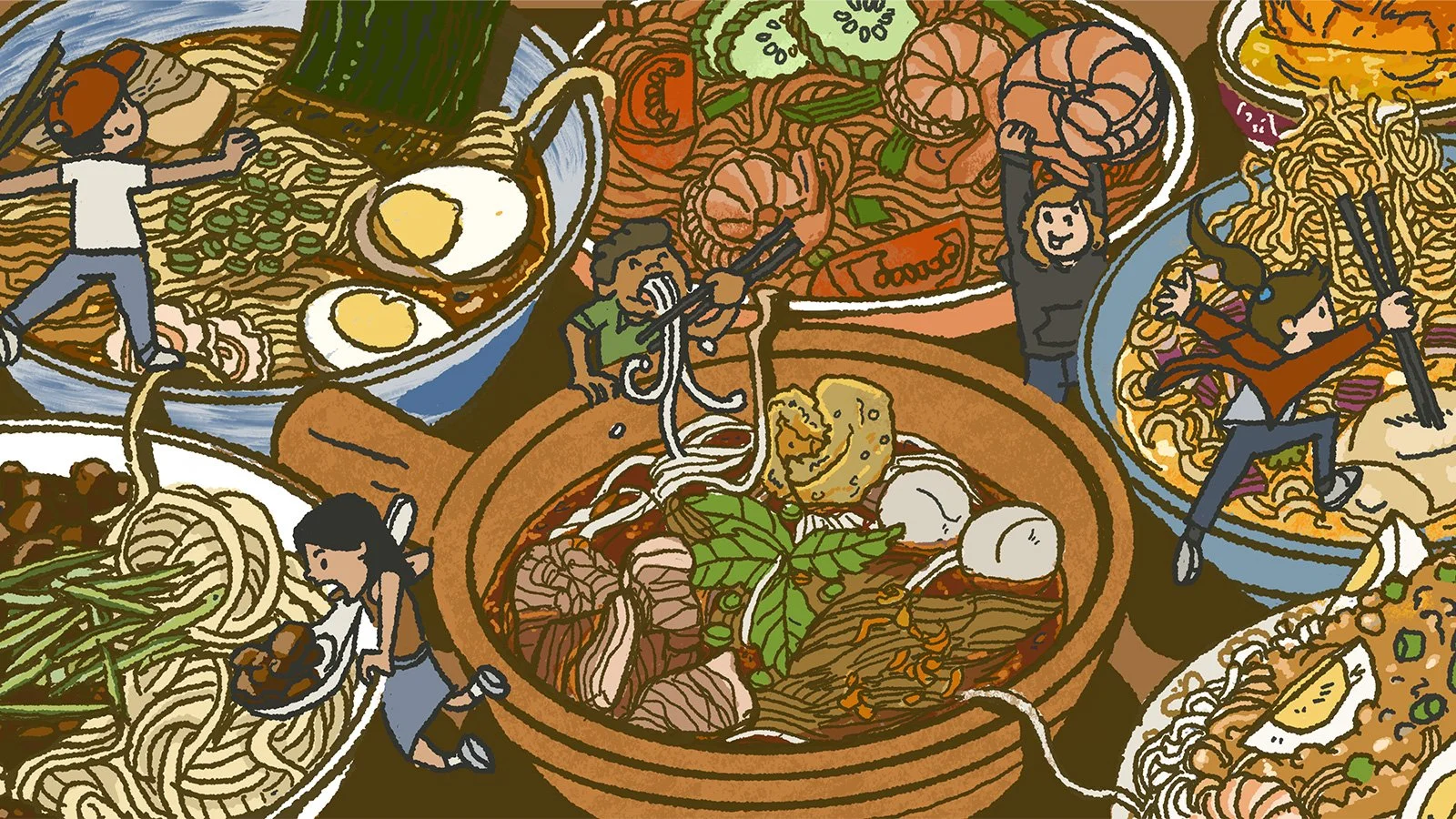
Thien Pham’s Noodle House celebrates diversity and deep connections through the universal language of food. “I chose the humble noodle because it reflects the many cultures represented in our community,” says Pham. “Each unique noodle dish carries its own traditions, memories, stories, and sense of home, while this ubiquitous ingredient ties us together. Noodle House honors and celebrates where we come from, where we are, what we share, and the new traditions we create together.”
By centering food as a bridge between past and present, Noodle House invites passersby to reflect on their own culinary traditions and the shared experiences that bind us together.
About the Artist
Thien Pham (b. 1975) is an Oakland-based graphic novelist, illustrator, and educator. His graphic novel “Family Style: Memories of an American from Vietnam” is a poignant memoir detailing his family’s immigration to America through the lens of memorable meals. Pham is also the illustrator behind KQED’s James Beard–nominated food series “Midnight Diners.”
Lui Art Wall: Kayan Cheung-Miaw
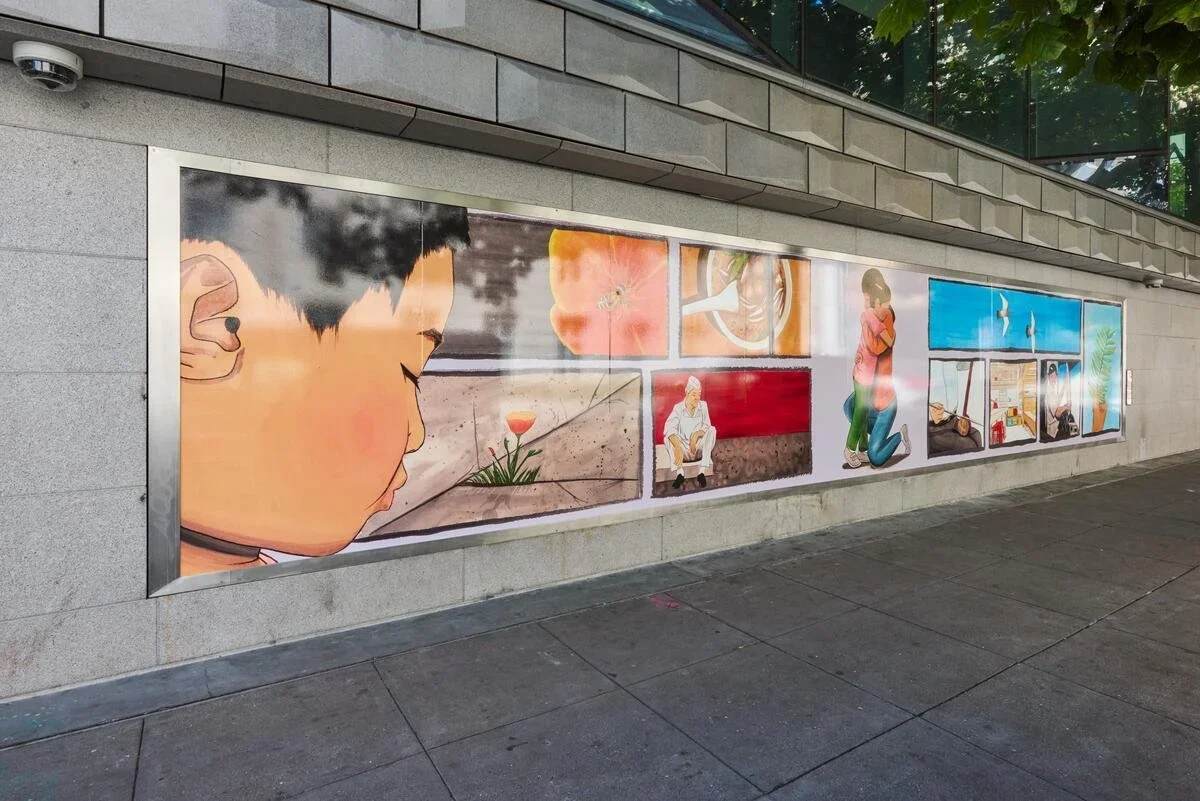
Commissioned by the Asian Art Museum for the Lawrence and Gorretti Lui Hyde Street Art Wall, Kayan Cheung-Miaw’s This Asian American Life asks: How might a child experience San Francisco’s Chinatown? In a series of panels, the mural slows the hectic pace of city life to highlight the special moments a child might focus on.
“My own time spent walking the streets of Chinatown takes me into a space where the sights, sounds, and people — their lives and especially their struggles — feel deeply familiar,” says Cheung-Miaw. “A child, by contrast, has the ability to get absorbed in and find wonder in almost anything.”
The mural depicts this working-class neighborhood — full of bustling restaurants, restaurant workers, crowded rooms, and public life — reflected through a child’s sensory experience of daily instances and encounters: the wings of a bee, the scent of a bowl of noodles, a cook taking a break, a bus driver waving hello, and the music from a gāo hú.
“This Asian American Life invites us to see Chinatown not only as an iconic neighborhood, but as a living archive of Asian American experiences, rich with everyday moments of resilience, labor, and care,” says Naz Cuguoglu, assistant curator of contemporary art. “By shifting our perspective to that of a child, Cheung-Miaw reminds us that even in the midst of struggle, wonder and beauty are everywhere, if we know how to look and listen.”
This Asian American Life is the latest work in Cheung-Miaw’s ongoing public art series highlighting the stories of Chinatown’s mothers, workers, and tenants, including a 2022 multilingual bus kiosk poster series based on residents’ oral histories. “The complexity of immigrant and Asian American life, particularly in San Francisco’s Chinatown, has been central to my projects and exhibitions in the past several years,” says the artist. “The real building blocks of my work are the stories of the women and men who have woven the fabric of our communities across oceans and ages.”
About the Artist
Kayan Cheung-Miaw (she/they) is a mother, artist, organizer, and educator, known locally both for their work as an organizer and for public art projects executed in their signature comic style. As an organizer, their leadership in a workers’ campaign for San Francisco’s Yank Sing restaurant resulted in a historic $4 million settlement for 280 workers. Originally from Hong Kong and raised in New York’s Chinatown, she holds an M.F.A. from the California College of the Arts and an M.A. from the University of San Francisco; she is currently based in North Carolina.
Press:
Mission Local
Lui Art Wall: Chelsea Ryoko Wong
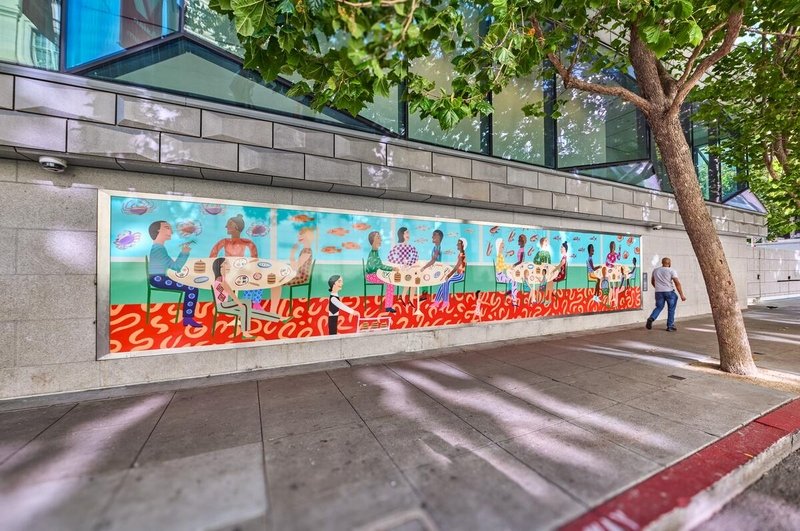
Community Feast by Chelsea Ryoko Wong (Chinese Japanese American, b. 1986) depicts a bustling, upbeat scene of diners at a Chinese dim sum restaurant. Commissioned by the Asian Art Museum in 2024 for the Lawrence and Gorretti Lui Hyde Street Art Wall, Wong’s painting reflects food’s powerful capacity to bring together people of different ages and backgrounds. “Civic Center is an area that encompasses many AAPI communities,” says Wong, “and the theme of dim sum felt particularly appropriate to the Asian American experience as it symbolizes harmony, prosperity, and closeness to family and friends.”
“In the wake of a disturbing surge in crimes against the AAPI community — some of which occurred in this neighborhood — it is imperative to create artworks that advocate for inclusivity and facilitate dialogue between different cultures,” explains the artist. “The Civic Center area is renowned for its ethnic, cultural, and economic diversity; this work aims to ensure that both residents and visitors feel acknowledged and reflected in its imagery.”
Painter and muralist Chelsea Ryoko Wong attended Parsons School of Design, New York and received her BFA in printmaking from California College of the Arts. She was the first recipient of the CAA Hamaguchi Emerging Artist Residency at Kala Institute in Berkeley (2010) and a finalist for SFMOMA’s esteemed SECA Art Award (2022). Wong lives and works in the Mission District of San Francisco; the installation of Community Feast on the Lui Art Wall coincides with a solo exhibition of her work at Jessica Silverman Gallery in San Francisco’s Chinatown.
Press:
Chelsea R Wong in Juxtapoz


Lui Art Wall: Dave Young Kim
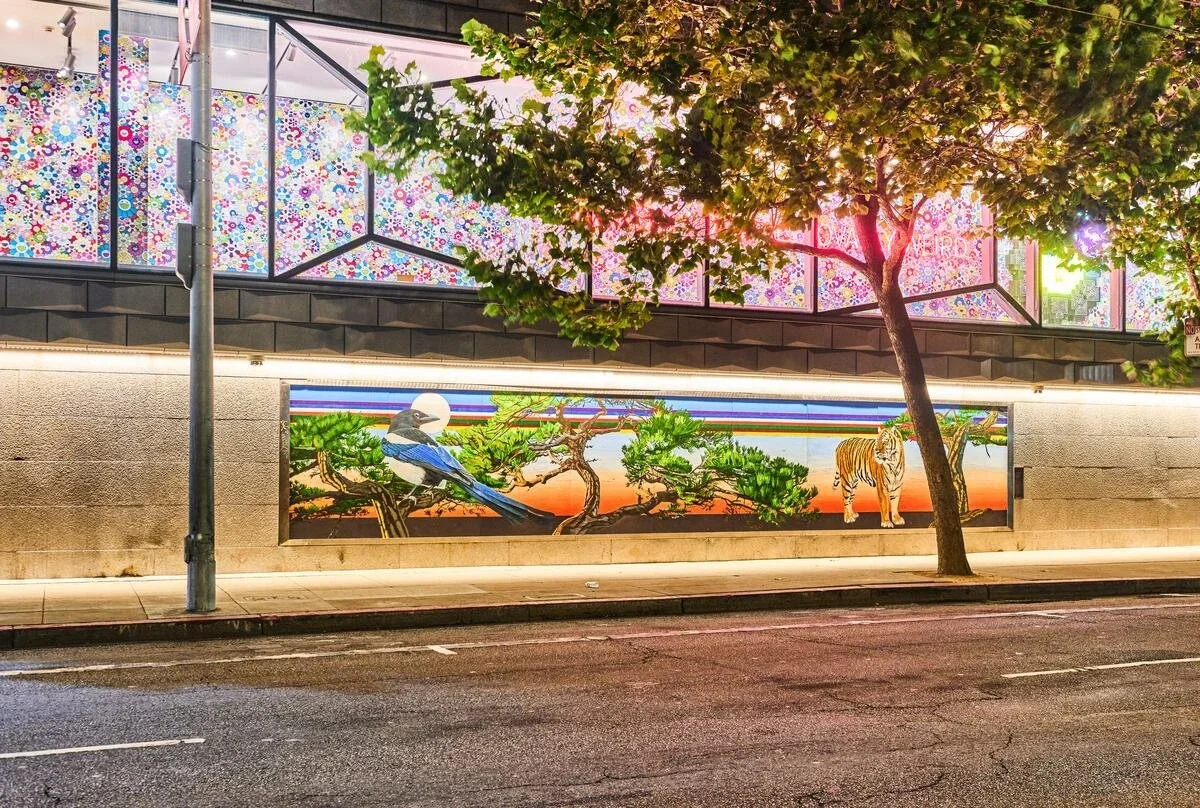
Jakhodo Today by Dave Young Kim (Korean American, b. 1979) was commissioned by the Asian Art Museum for the Lawrence and Gorretti Lui Hyde Street Art Wall and installed in 2023. Kim’s composition draws inspiration from Korean folk paintings of the Joseon dynasty (1392–1910). The tiger and magpie pairing appears so frequently in Korean art that it comprises its own genre: jakhodo, paintings depicting tigers and magpies. As tigers were believed to expel evil spirits and magpies represented bearers of good news, paintings of this duo were sometimes placed on the front gates or doors of houses to bring good luck. In time, a political dimension also emerged: caricatured as a foolish oaf, the tiger became a symbol for the aristocratic yangban, while the dignified magpie represented the common people; the display of such imagery allowed villagers to quietly rebel against the ruling class. The mural’s saekdong (colorful stripes) are a decorative element often used to adorn clothes and traditionally thought to summon good fortune. Their five or seven colored stripes originated with the concept of eumyang-ohaeng, or yin and yang, and the five elements.
The tiger and magpie appear on several artworks in the museum’s collection of Korean art. Kim notes that many Korean Americans may have grown up with such imagery without being privy to the symbolism behind it. “It speaks of the familiarity of gleaned tradition without having knowledge of the deeper context or ancestral culture,” says Kim; “this is the immigrant story.”
Dave Young Kim is a Los Angeles-based artist with Bay Area roots. A co-founder of the Korean American Artist Collective, Kim often uses the specific to address universal ideas of the human condition in his artwork. Fundamentally, he explains, his work speaks to the premise that “we are all looking for a place to call home.”
Powered by Squarespace